
Here I explore how we can model stakeholder management in our minds, and on paper - with a view to making sense of the noise, and helping one prioritise precious time with the stakeholders who matter.
I've included a small interactive AI tool at the bottom to help guide you through the thinking.
Why it's Important to Product Practice
A common problem I've observed with my own product teams is PMs being overwhelmed with the amount of stakeholder management which needs to take place - "I've got 100 emails from different stakeholders this week", "Why is this one operational level user causing so much noise?", "How do I keep this person and that person informed?"
In my opinion, being able to categorise, filter and sort various stakeholders across various B2B clients helps Product leaders spend their time engaging with the people that matter. Being able to tailor one's approach to those categories a) saves on your sanity, b) gives biggest bang for the buck.
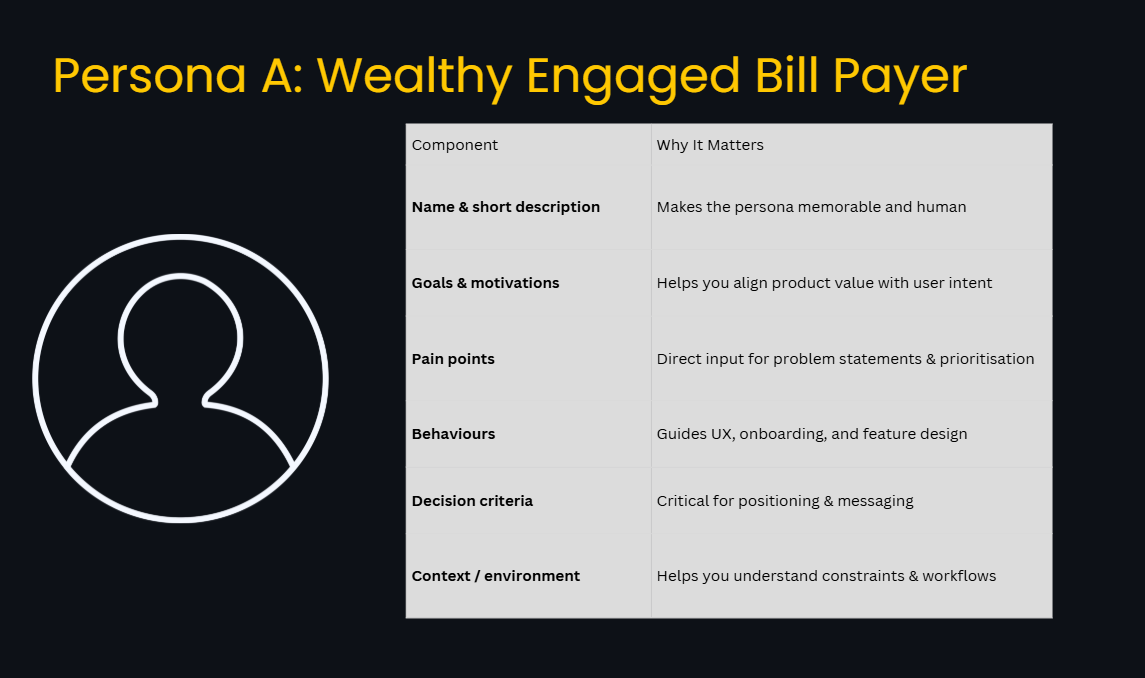
I should note, this technique doesn't replace the need for understanding your customer personas - mapping your stakeholders complements your personas - it's a slightly different lens - both should be applied.
Why it's Often Overlooked
Some of this we do implicitly - we understand that - but by not being explicit about it, we're working on assumptions and frankly, guessing and feeling our way through.
People usually skip it because a) it takes a bit of time to get right, b) it's not fool proof.
How to Think About it - the Models
At a high level, we can broadly rate stakeholders in terms of the following attributes:
- Power & Influence - Obviously power and influence are important attributes, especially when overlayed with other attributes. You probably already prioritise a direct email from the CPO over an email from an ops user, but that's quite broad strokes and should be applied with other nuance.
- Urgency - Useful to be aware of the kind of urgency expected from each stakeholder. Doesn't mean we automatically give that attention and urgency - this again needs to be plotted against other dimensions - but how often and how urgently stakeholders expect communication is a useful lens.
- Legitimacy & Knowledge (or lack of) - This is an important factor not to undervalue. A common mistake is assuming a level of knowledge which might not be there. Equally if someone is very knowledgeable in a specific area it might change our communication style. Being aware of a stakeholder's knowledge and being explicit about that in our thinking helps us frame how we manage them.
- Support & Interest (or lack of) - Stakeholders who are supporters and advocates of your product can be prized assets. Equally, detractors are useful to be aware of - understanding their frustrations and what might turn them into a 'supporter' can be reflected in your communication and engagement methods.
- Communication Style - Another key one to be aware of, and another one people overlook. It shouldn't take me to point out that some people have a direct communication style and like direct comms, whereas others might prefer a relationship-driven style. Being aware of this helps us tailor our approach.
Having assessed each stakeholder by those attributes, we can use various models to give us different lenses of the stakeholder landscape:
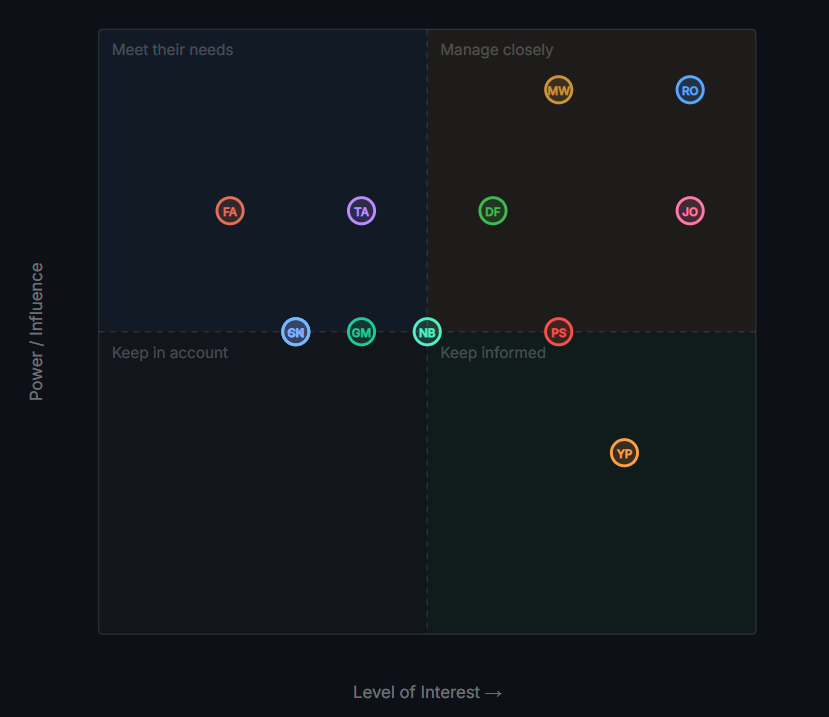
- Power / Interest Grid - Plots power/influence against interest, allowing sorting by a) manage closely, b) meet their needs, c) keep informed, d) keep in account.
- Knowledge / Support Grid - Plots amount of knowledge over degree of support, allowing sorting into a) aware and supportive, b) aware and opposing, c) ignorant and supportive, d) ignorant and opposing.
- Salience Model - "the quality of being particularly noticeable or important; prominence" - using a Venn diagram we can classify stakeholders according to power, legitimacy and urgency, giving us 7 segments: dormant, discretionary, demanding, dominant, dangerous, dependent, and definitive.
How to Use This Tool
Think about your top 15 stakeholders. Who are they? What are their roles? Then, think about and rate on each card:
- Whether they're internal or external, and what communication style they gravitate towards
- Their level of influence over your strategy
- Their stance towards your product
- Their engagement level
- Their domain expertise
- The urgency of their needs
- Their specific areas of interest, and the tags you would use to describe them
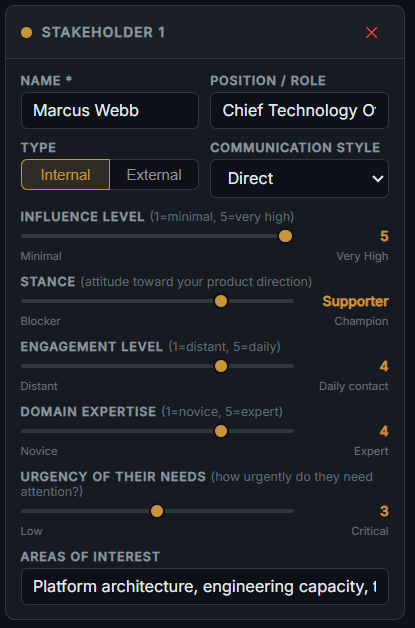
Completing a stakeholder card - rate each dimension to build a picture of each person's profile.
Then, hit the analyse stakeholder button, and the AI will plot those stakeholders across three lenses simultaneously:
Power / Interest Grid
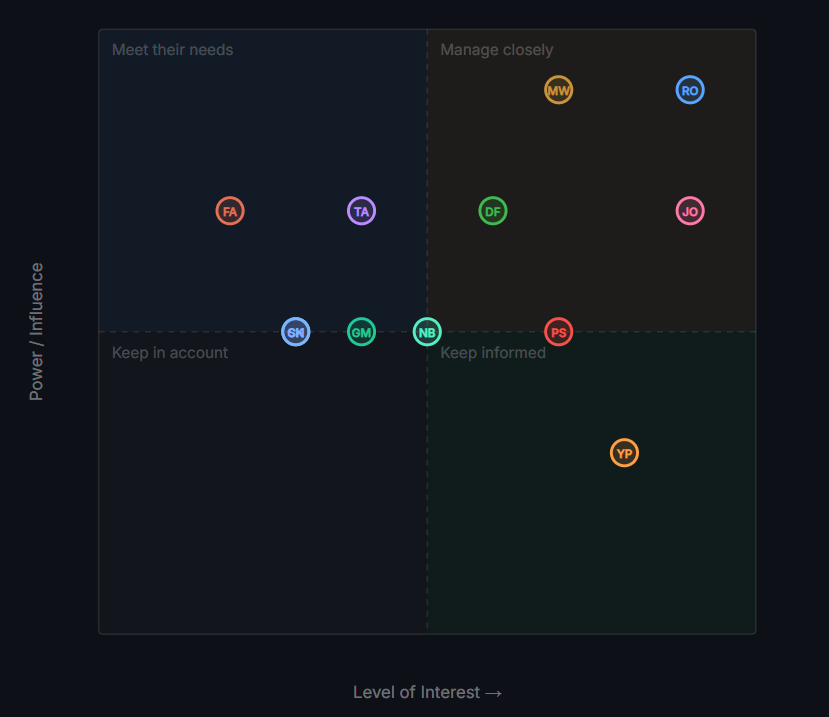
Knowledge / Support Grid
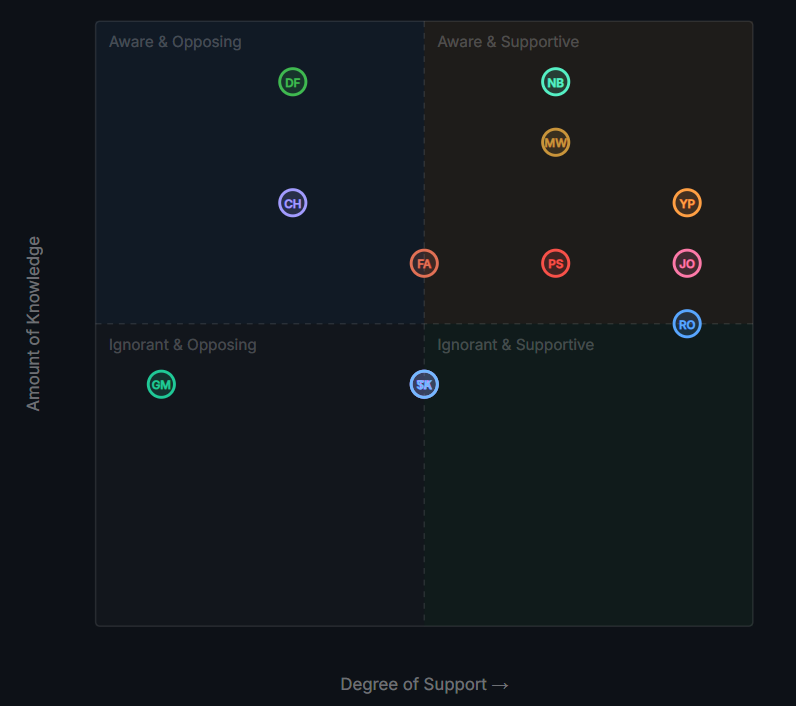
Salience Model
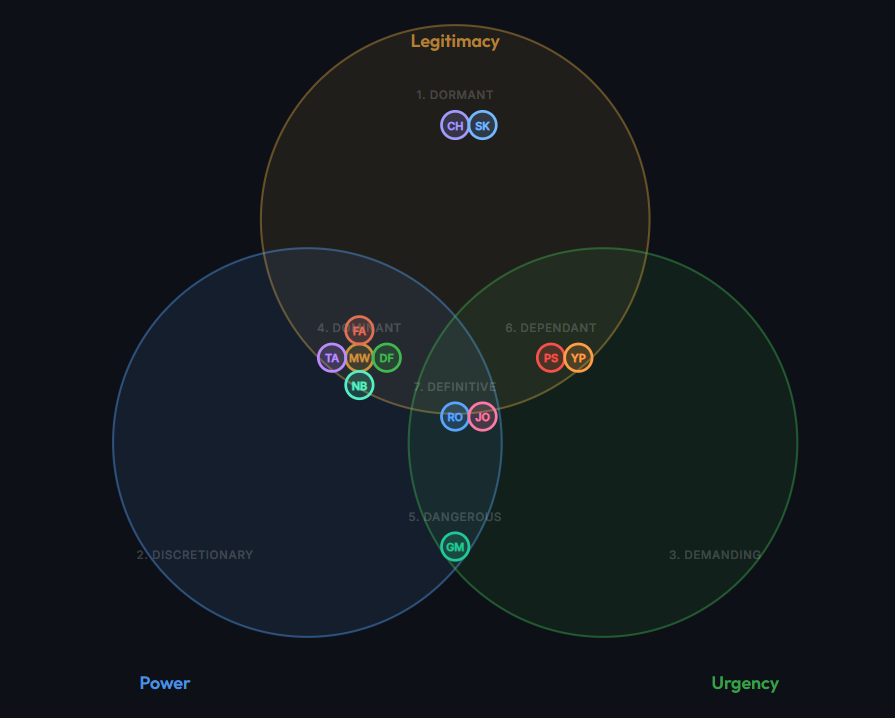
The goal is not to categorise people for the sake of it - it's to make conscious, deliberate choices about where you spend your energy, and how you communicate when you do.
A Note of Caution
These models just help with framing and understanding - to help you bring some science to manage the chaos. There is still a human element of intuition that comes with this, we understand that. So treat the outputs as a guide, not gospel. This tool is meant to aid thinking rather than provide bullet proof instructions on how to manage stakeholders.
Don't confuse this with customer personas. Whilst at times a particular person might be both a user persona and a stakeholder, don't confuse the two techniques. For more on the topic of Customer Personas, try the Customer Persona Builder here.
How does your team approach stakeholder mapping? I'd love to hear what frameworks and approaches work for you.