
In this post I open the box on how I personally build high performing teams - starting from the ground up: setting the direction, identifying and leveraging team strengths, developing individuals, and the qualities of leadership that hold it all together, drawing on the example of successful sports teams throughout.
I've included some practical resources along the way to help.
Foundations - Clear Goals, Strategy & Objectives
The first and most important step in mobilising a team is to be very clear and explicit about the things we are trying to achieve.
I know this sounds obvious, but it's surprising how often I've joined or inherited teams where the goals are not clear and obvious. You speak to one exec and they think the goal is X. The team is aware of X, but their current priorities are trying to address Y. And the architect has a whole list of priorities which target everything but X or Y.
Sound like a familiar pattern? The root cause of this misalignment is often a lack of time spent debating and agreeing what the actual short, medium and long term goals really are. Time and time again I see it - the goals are loose dreams, undefined, and often there are simply too many of them.
Now compare this to the most successful sports teams. What you'll see is that they have, as a basis, a really clear objective and goal they are trying to achieve. It might not always be to "win the cup" - it might be to progress to a certain point, or be better than last year - but the point is every team member is clear on what they're trying to achieve. You can't move forward without these foundations.
So one of my main pieces of advice is to make goal-setting a deliberate and explicit exercise. Make sure everyone's opinion is accounted for - this helps avoid the "elephant in the room" goals - then write them down, debate them, and lock them in. Ensure every product line, team and individual understands how their contribution plays into the strategic goals.
Obviously, I'd encourage you to start with the company OKRs and use an OKR cascade to derive the objectives and key results for each of your products and teams. I won't go into detail on that here, as I have a whole guide on setting goals that matter and a tool to help with it.
The 5 Dysfunctions of a Team (Culture)
A mentor of mine once gave me a book, and it was game changing for me - The Five Dysfunctions of a Team by Patrick Lencioni.
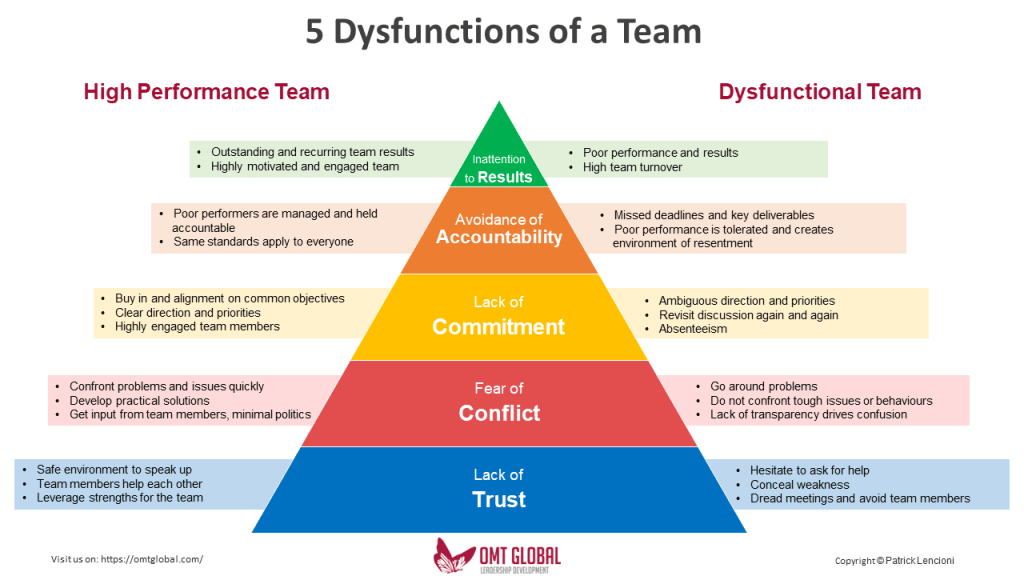
Diagram credit: OMT Global, based on the model from Patrick Lencioni's The Five Dysfunctions of a Team.
I won't give a full synopsis of the book here (I've linked a great one below), but being aware of these dysfunctions, being able to spot them, and having tools to remedy them, is hugely important. Again, using the sports team analogy - if you listen to or read the experiences of players and coaches in winning teams, they talk about the same core aspects of building high performing teams:
- A high-trust environment - team members help each other and speak up without hesitation.
- Candour and openness to resolve conflict - problems get confronted quickly rather than avoided.
- Commitment and buy-in to the cause - clear direction that everyone has genuinely bought into.
- Accountability amongst the group - the same standards apply to everyone.
- A collective focus on the result - the team is judged on outcomes, not effort or busyness.
The solutions are often quite simple, but still require high emotional intelligence. For example:
To build trust amongst the group, this can be as simple as team building exercises, group problem-solving, or personal histories exercises designed to introduce the concept of vulnerability to the group.
To prevent a lack of commitment, you can involve the team in decision-making ("weigh-in to buy-in"), be clear and explicit about the team's goals, and celebrate achievements regularly. Having a team of highly engaged colleagues really helps with this - but what you're trying to avoid is the phrase "I didn't sign up to that" by making sure all the relevant opinions were included in the first place.
A common pitfall I often see is a fear of healthy conflict. Interestingly, it can be particularly pervasive at senior level - I've seen it undermine entire programmes of work and erode client confidence, because there were no mechanisms for internal teams to disagree agreeably, and no resolution to small conflicts - which left problems festering under the surface, despite lots of smiles and warm feelings in meetings. If you find yourself reaching for this meme a lot in the work chats, you might be seeing it too.
The final thing worth noting is that all the dysfunctions are linked and related - you rarely have one without an element of the others. By improving trust and accountability, you're also likely to have a positive effect on the rest.
So what practical things can one do? Where can you start? In my experience, a great place to start is the 5 Dysfunctions team assessment. Many facilitators are trained to run this exercise with teams, and it's a great foundation to work from - putting data to what you might already feel and observe, and offering suggestions to help, based on your specific team.
Personally I'd recommend the services of someone like Justin Standfield from Incendo - an independent consultant and facilitator who specialises in increasing leaders' impact, and can facilitate a number of insightful workshops, not limited to the 5 Dysfunctions of a Team.
Identify & Leverage Team Strengths (Tactics)
Think of any high performing team you know from sport - they'll all have distinct traits they lean on as a strength. Depending on the sport, different traits matter - physical attributes, technical acumen, strong attacking or defensive play. Often these teams have players who are exceptionally strong in these areas, and the team is built to leverage it.
Like all high performing sports teams, identifying and working to the team's and individuals' strengths is the basis of being successful. Honing those strengths, repeating them and becoming better at them for match day is core to what teams do - but equally important is training in the areas of team weakness. These are transferable lessons we can apply when building teams within businesses.
What sort of strengths are we talking about in a product team? A few of the obvious ones (not an exhaustive list):
- Product discipline
- Stakeholder & client management
- Technical & AI skills
- SME knowledge
- Public speaking & presenting
- Complex problem solving
- Strategic thinking
This isn't about pigeon-holing people, but if we can recognise where we have exceptional people in these areas, it's genuinely valuable. When I take responsibility for a new team, I think of it like this (you probably do too, instinctively - here's a nice way to visualise it):
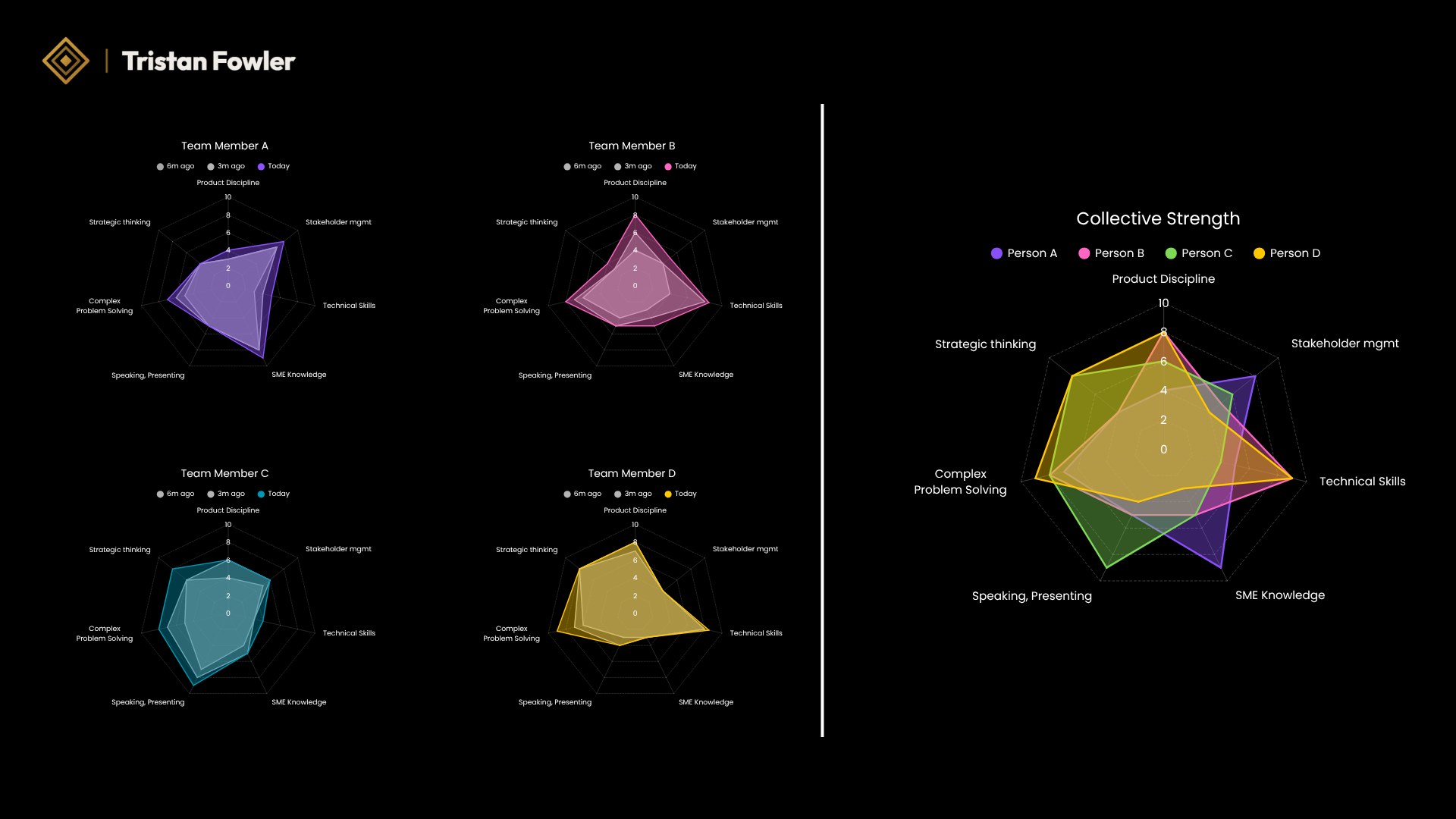
Individual radar profiles, overlaid into a single Collective Strength view - where does the team genuinely have coverage, and where doesn't it?
What I'm essentially trying to do here is make sure we have all the bases covered for everything the team needs to do, with good coverage of high quality across the board - whilst accepting that each individual brings something different to the table.
In this example the team is strong - every aspect of what this fictional team needs has quality we can put on the job, and skills we can share amongst the team. If you did this yourself for real, you might find an area the team needs to develop, which is then what gets worked into training and development plans.
To try this yourself:
- Decide on the tactical skills that matter, and list them out.
- Work with team members to understand where they excel - use ratings from 1-10.
- Plot that into a chart. I did this in Canva, but Excel does it too.
- Repeat the exercise every three months, and use the data to inform how you develop the team through training, coaching, and so on.
Development & Coaching Plans (Training)
Establishing coaching and development plans for the individuals on a team also contributes to the team's collective development.
From sport we know that results on match day largely come from the training pitch. This should feel inherent, but in the heat of projects, SLAs, roadmaps and day-to-day business, it's often overlooked.
What often happens in business is either a) there are some vague bullet points in a quarterly review form somewhere with no plan and no commitment to the growth, or b) each individual has a development plan, but a collective development plan for the team doesn't exist - in other words, nobody is checking whether the team is covering all its tactical bases.
So using the radar charts from the previous section, what I try to do is look at the whole team's composition. This lets me focus in on the specific areas of development we have as a team, and weave that into individual development plans - the point being, all individual development plans should ideally align to making the team stronger overall, as well as making individuals stronger.
I'd also recommend group training exercises and long-term pairing as methods to raise the standard across the group:
- Group Training Exercises - exactly what it sounds like: a specific session where someone who excels in a given area shows the team how they do it, then everyone works through a live example problem to put it into practice.
- Long Term Pairing - encouraging two people with complementary skillsets to spend time with each other and cross-pollinate experience and skills.
As a small example of long-term pairing in practice, I was once fortunate enough to work on a team where one person had exceptional product discipline and organisational skills, and another was exceptional in the domain area, with a long history in the product. We put them together - encouraged them to spend time together, to work through problems side by side.
It wasn't easy to begin with - two different styles coming together, with some teething issues. The good thing was these two people were excellent characters who displayed high-trust behaviours every day, so they stuck with it.
It took a good six months for the full fruits to come through, but what I saw was two people exchange skills and both become more capable as a result. They spent time with each other and learned from each other. I won't mention names here - they both know who they are - but they exchanged these skills in the most spectacular way. One learned about product roadmaps, prioritisation, BPMN. The other learned about UK energy supply and the complexities within. Between them, they solved some very complex problems that others had looked at but given up on before - complex business orchestrations around metering information and backdated consumption histories.
The power of this example is a small but direct illustration of how a team (in this case, two people) can become greater than the sum of its parts by working together with high trust, and exchanging strengths. I have countless other examples of where this has worked.
Helping with Imposter Syndrome
Many times in my career I have come across team members who suffer from imposter syndrome. It's amazing how common it is, even amongst over-performers - people thinking they aren't good enough, despite being genuinely excellent at their job.
What we're really trying to do here is help the person reflect on their achievements, relationships and experience, and draw strength from those - but also put in place a positive action plan for what a person dealing with imposter syndrome feels is causing it (their own perceived weaknesses).
To help people through this in the past, I've used a simple whiteboard exercise that works through, in the person's own words:
- Their achievements
- Their key relationships
- Things they are proud of
- Their perceived development areas - the causes of the imposter syndrome
- Concrete actions to address the causes
- The action plan
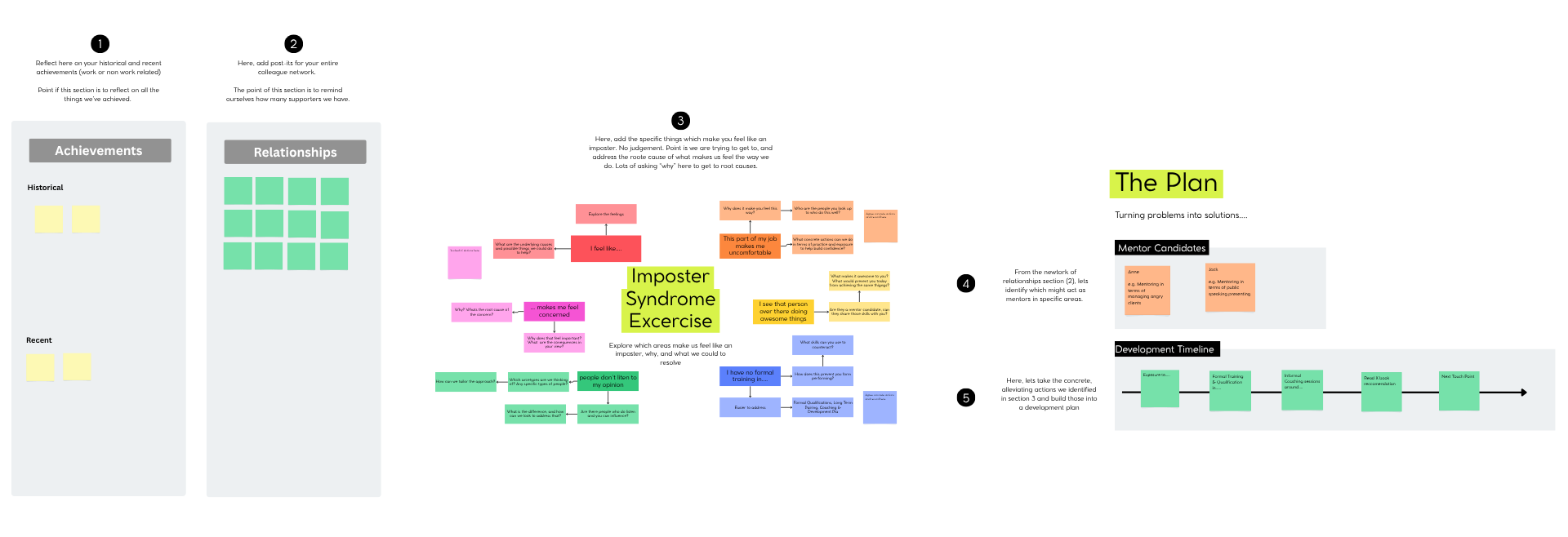
The Imposter Syndrome Canvas - working through achievements, relationships, the root causes, and a concrete plan.
The point of the exercise is to act as a safe space for the person dealing with imposter syndrome to explore what makes them feel that way and why, and then put in place a positive action plan of things that can help build confidence.
I could write a whole article on how to facilitate the thinking required in these sessions, and the questions one can ask, but suffice to say for now - this is about helping someone work through what they feel (not talking at them about development and coaching), and then helping them identify ways to alleviate those feelings. Often we can feel imposter syndrome but not really know why - it's the facilitator's job to get under the surface and help the person draw out the reasons.
This exercise should not be used in place of standard "review" type development plans. Although similar in look and feel, and probably related, this exercise aims to dig into the feelings rather than the tangible competencies. In my experience running these sessions, it's often the people who excel in a specific area who also suffer from imposter syndrome around the very thing they're known to be strong in.
In these sessions, as a leader you might have to display more traits of a counsellor than a manager - you're trying to help someone uncover feelings, not necessarily coach them. There are different sessions for that.
One thing to note - this is not a magic bullet or one-time exercise that fixes everything. I've found that people dealing with this might need repeated sessions to reflect on recent achievements, take confidence from them, and focus in again on the concrete things which alleviate the feelings.
Authenticity, Servant Leadership & Leadership Agility (Matchday)
If you're a leader trying to implement some of the practices above, what shouldn't be underestimated is the power of being authentic and displaying a servant leader mentality. It's arguably the most important part. All of the target-setting, coaching and tactics come together as a framework for success - but it's the leader who determines whether the team actually executes on it.
In my opinion, there's a strong correlation between successful teams and leaders who are authentic and exude a servant leadership mentality.
I know that sounds a bit fluffy, so to illustrate: think about the best, most productive team you've been part of. What made the team great, and what behaviours did the leader display? I'd be willing to bet that aside from the leader doing the basics right - setting clear goals and objectives, having the right strategy and tactics in place - what you probably valued was their authenticity, and having them listen to you, serve you, and encourage your progress.
Conversely, think of times in your career where you didn't enjoy working on a team or for a leader. What made it a poor experience? I'd imagine that beyond the surface issues - not making progress, or too many goals being chased - underlying it is probably a leader who lacked authenticity, or who treated you as the one in service to them.
What does servant leadership mean, and how does it manifest? Listening and emotional intelligence. Action over bureaucracy. Attention to detail and curiosity. Being prepared to lead from the front. Telling hard truths gently, not sugar-coating them.
I've focused a lot on servant leadership style here, and there are other leadership styles available. What's actually required, above any particular style, is leadership agility - the ability to bring a number of leadership styles to bear, based on the situation and the team in front of you. Starting with a servant leader style is a good place to begin though.
Summary
So in summary, these are, in my opinion, the core aspects that form the foundation of building high performing teams. There's lots more that goes into it, but these are the real-life methods I've used to build teams that achieved big things:
- Clear goals, strategy and objectives
- A culture of trust, healthy debate, commitment, accountability and attention to results
- The right tactics in place to leverage excellence across the team
- Supporting and developing the individuals who make up the team
- Being an authentic, servant leader
Bring all of these things together and you have the foundations for creating and maintaining a high-performance, motivated and happy team that gets results.
How do you build high performing teams? What matters most to you? If you have any questions or thoughts on any of this, I'd be happy to hear from you.