Context & Framing
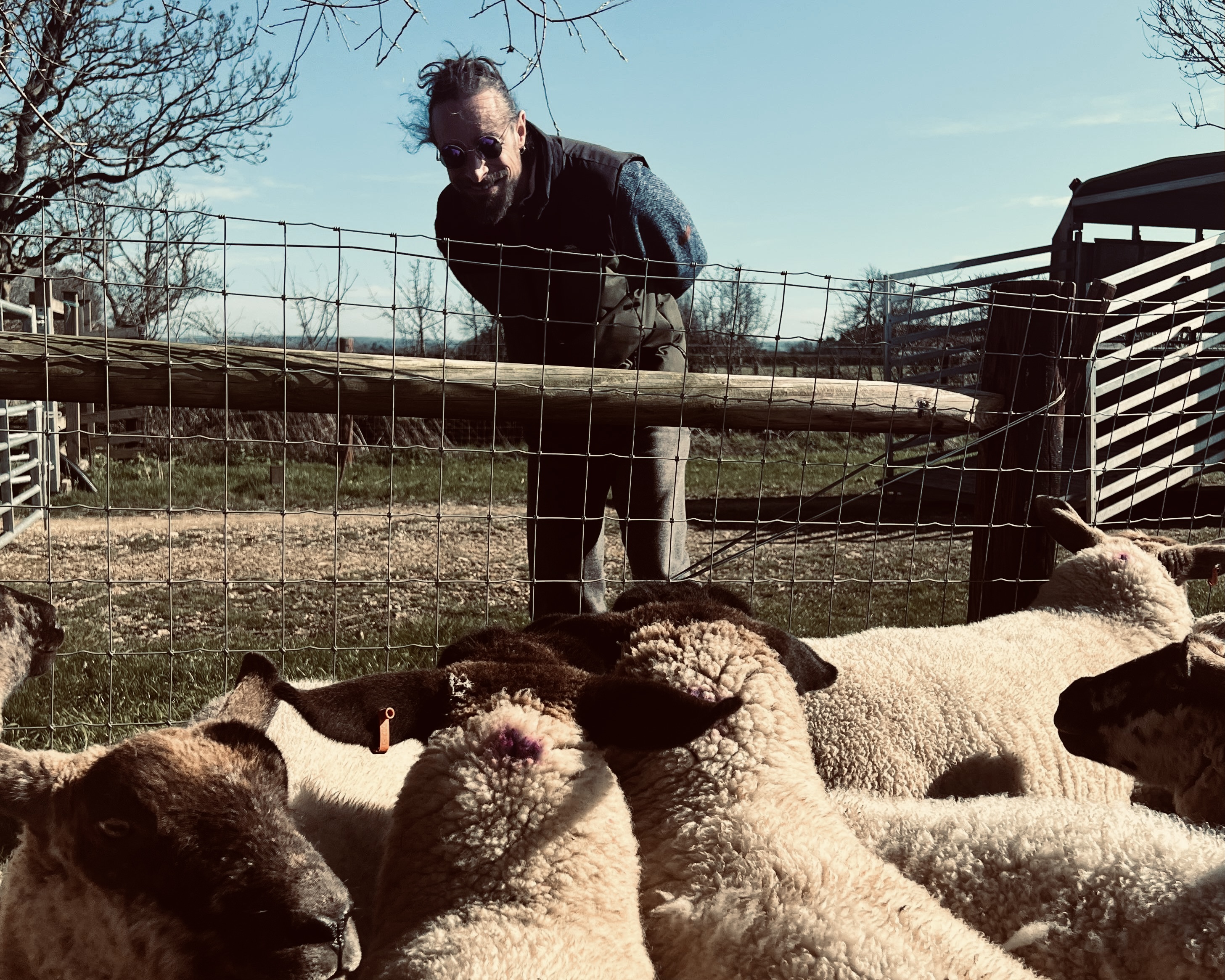
Cropwell Farm Shop is a family run business close to me (I've been a customer there for years), run by Sarah and Steve. As you might imagine from a farm shop - they specialise in local produce - from grass fed lamb to locally grown and sourced veg, they don't specialise in tech.
They have maintained a successful and stable business, mainly through physical footfall into the shop via word of mouth and a strong local reputation, or through delivery in the local area, which they do themselves. They are very busy people. They maintain a farm, run a shop, and run a local delivery service.
However in terms of digital footprint and online sales, they felt they were missing some market opportunity - they had an aging Shopify shop, a portfolio of around 10k online customers, but not as many online orders as they would like - mostly incoming by phone and WhatsApp.
So we set about trying to improve the e-commerce side of their business - improving their website, increasing their digital profile, and improving the customer experience of their digital store.
Phase 0 - Preparation
First things first, I set about "establishing the OKRs" 😂 - what objectives and key results are we trying to meet? After a few separate discussions trying to establish exactly what he was hoping to achieve, we broadly agreed on the following.
Steve's eyes glazed over slightly at the word 'OKRs', but once we translated them into plain English, we landed on:
- "Increase revenue from online sales by 2-3x what it is today"
- "Increase customers opting for online pickup over delivery (baseline 0:100 in favour of delivery, target 50:50)"
- "Reduce number of refunded orders due to being outside delivery area (baseline 20% of orders, target <5%)"
- "Reduce number of abandoned carts by 40% compared to the number we have seen today"
- "Improve customer feedback around online shop functionality, particularly the number of complaints we get about things not working correctly."
During these same discussions I also gently teased out the Customer Personas over a number of conversations. Remember I had to do this gently - Steve is not from a corporate world, he didn't exactly have a CSV file with all his customer preferences.
- "Long standing legacy Customer" - Important customers! Spend well, order repeatedly, not particularly tech literate - user facing changes being seamless is important. Also, these customers do engage on Facebook.
- "Direct & Urgent Professional" - Usually in mid-30s, early 40s - everything from electricians to tech workers. Want click and collect as a feature, doesn't want to wait in a queue, also spend well and repeatedly.
- "Organic Mum" - Likes to feel connected to the produce, wants to know what they are getting is free range and organic, and how it is sourced.
- "B2B Bulk Buyer" - Restaurants, pubs, hotels etc. Make up a good segment of revenue. Like to order in bulk. Immediate VAT receipts is a current gap for them.
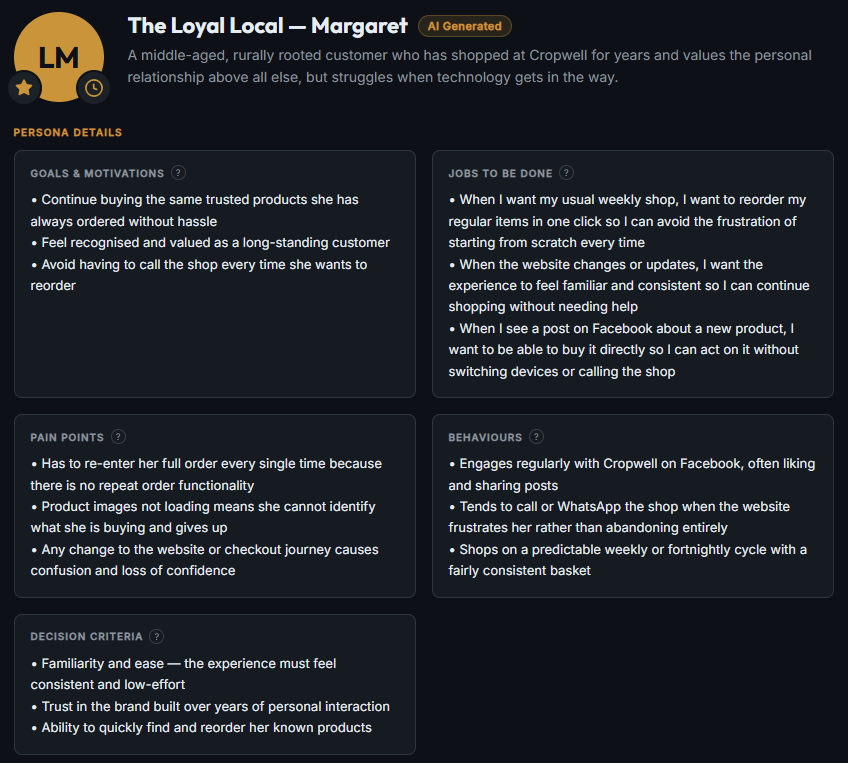
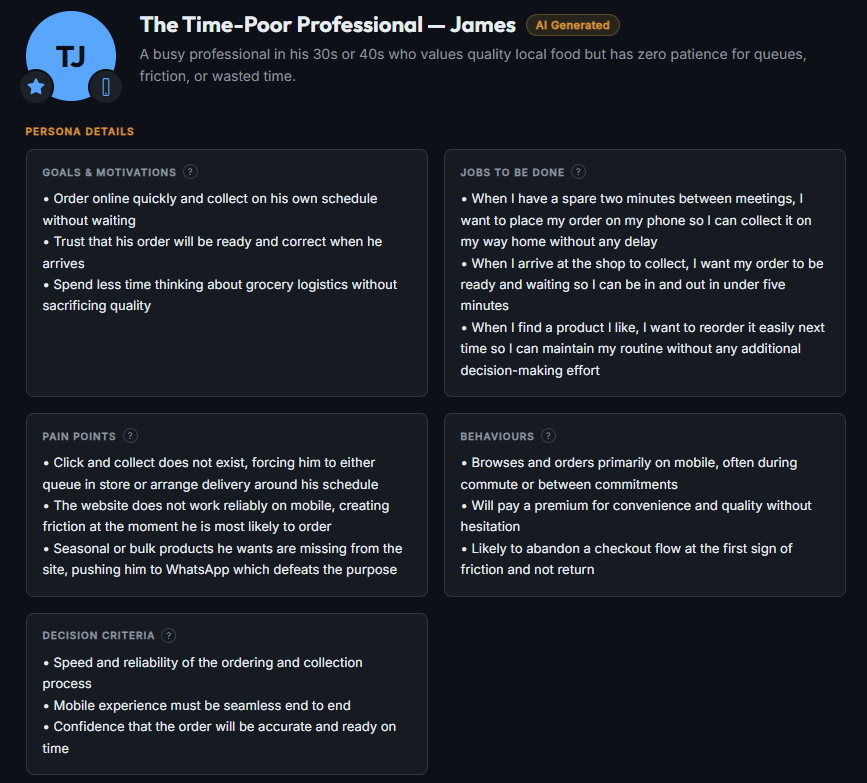
In order to make direct contact with users, I had to spend time in the shop, actually speaking to customers about how they use, or don't use, the website. I actually managed to speak to 3 out of 4 of those personas - the urgent professionals, the business owners, the long standing customers. The interesting challenge was trying to quickly note down these conversations - happening at a farm shop till - into useful data, which I would later use with the farmer for strategy prioritisation. In the end I opted for this:
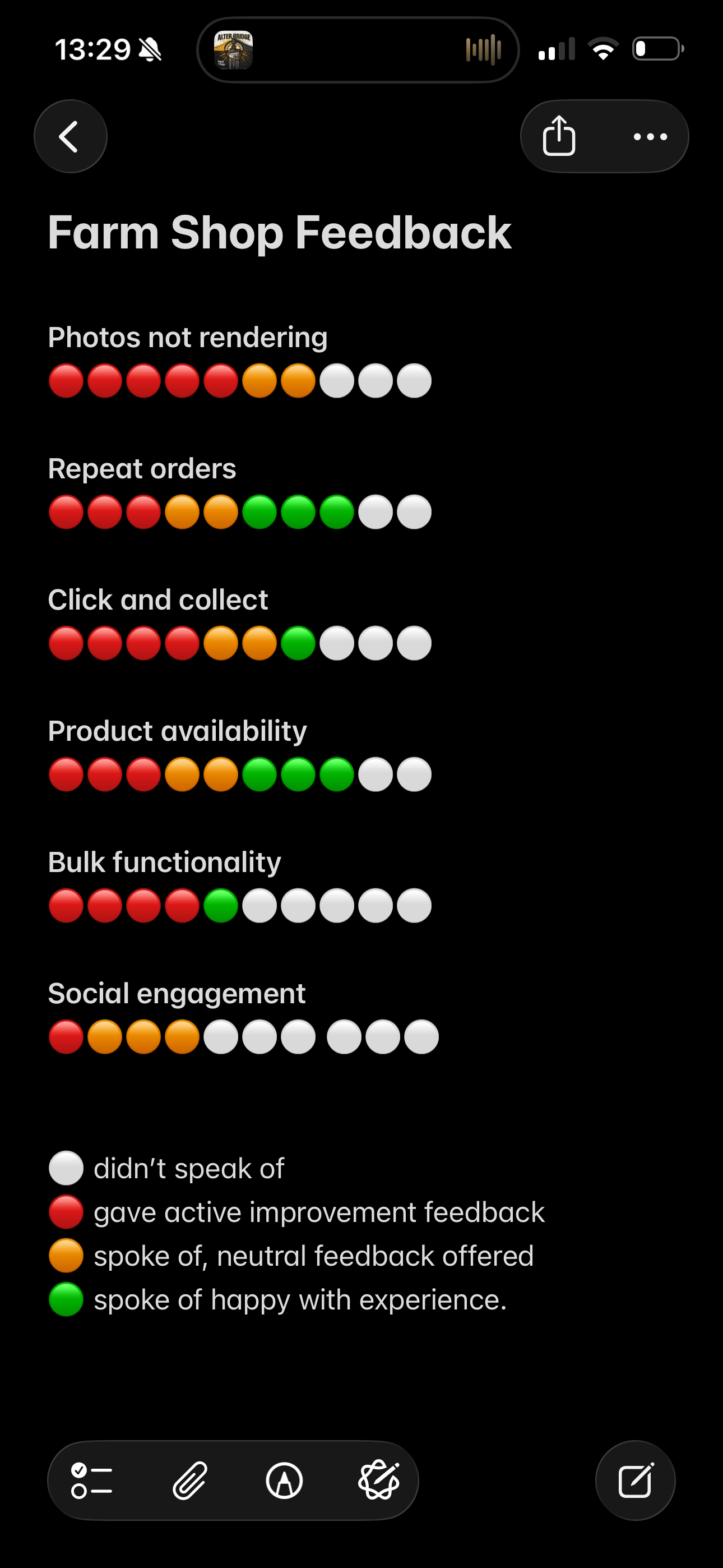
Old school customer research - notepad at the till.
Resulting Customer Challenges
- Product photos not rendering - Nearly all customers mentioned this as the primary reason they didn't use the current site. They couldn't identify the products they wanted and gave up.
- Repeat orders really painful - No functionality exists, so faithful customers would re-enter everything every time, and everyone else gave up and called in instead.
- Click and collect not available - I didn't need to ask for this, people were literally asking Steve for this functionality, unprompted, at the counter, wondering why it's not available.
- Products out of date - 3 or 4 customers mentioned they prefer to browse in the physical store because seasonal products were not updated, or the size they want wasn't available.
- Bulk bundles not available - A few customers mentioned that they usually order by WhatsApp because there are certain bundles available which are not even on the website.
- Product ranges don't cater for the range of personas and different sizes - similar for business customers who order big batches - the website doesn't account for this, and all the pricing reflects small order pricing.
Some Other Operational Challenges
- VAT invoices being produced manually - Business customers wanted their invoices immediately available, automating that would be another quick win.
- Lots of refunds due to delivery area mismatch - Another key issue was the number of orders from people outside the delivery area, resulting in refunds needing to be issued (farm produce doesn't ship well).
- Constraint by way of needing to continue to use Shopify - Seamless for customers, less admin for the farmer - Steve was used to managing his customers in a specific way and had thousands of products in Shopify. Migrating all of that to another tool was not really appetising.
- Lots of cart abandons - Probably associated with all of the customer feedback above, but the number of abandoned carts pointed to blockers in the checkout journey.
- Mixed brand identity - P&P vs CFS - Steve had a Parsnips and Pears website, but Cropwell Farm Shop Facebook channels and branding - this wasn't helping his identity and needed cleaning up.
- No content being produced - Steve would produce some pictures of meats etc, but nothing that brings the farm to life. Average of 2-3 likes per post, no other engagement.
Planning the Strategy
Having spent time getting to know the shop's customers and what was important to them, we planned out the strategy for the next few weeks:
- Resolve the current website faults on the existing website - easy stuff, quick wins.
- Enable Click & Collect, set delivery controls - also quick wins, but solving key problems.
- Build a fresh new site outside of Shopify themes - the main stage: repeat orders, retiring the old site, etc. Utilise Shopify Hydrogen headless to achieve it.
- Open up the digital/social channels, create content - the value add.
You don't always need a six-month discovery sprint. Sometimes you just need to stand at a farm shop till for a day and actually listen.
In part two, we get into the actual doing - the fixes, the build, and the somewhat chaotic go-live. Read on...
Helping a Local Farm Shop - Mini Series